Volkswagen’s Strategic Investment in Rivian: A Software-First Partnership Beyond Electric Trucks
Introduction
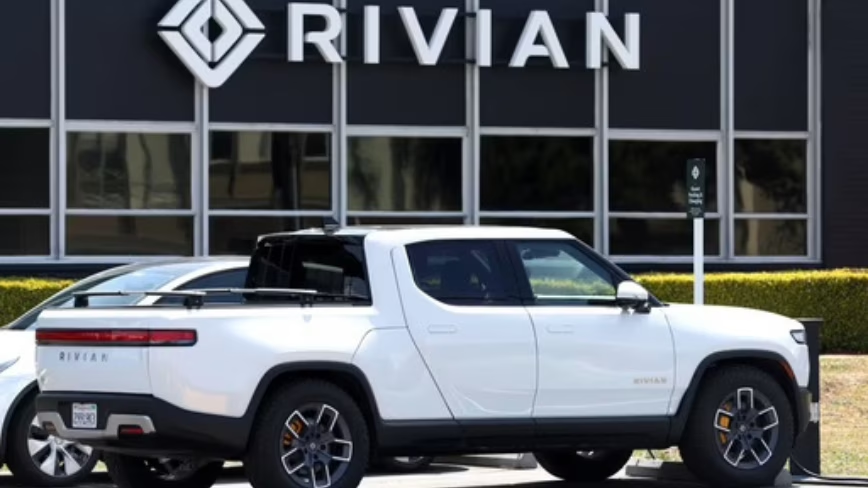
In a move that reshapes the competitive landscape of electric vehicle (EV) technology, Volkswagen Group has emerged as Rivian’s largest investor. The German automaker’s multi-billion-dollar commitment does not signal a desire to acquire Rivian’s acclaimed pickup trucks or SUVs. Instead, it targets a far more valuable asset: the software-defined vehicle platform that Rivian’s engineers have built—technology that Volkswagen’s own teams reportedly struggled to develop independently.
The Investment: What Volkswagen Bought
Volkswagen’s investment, announced in late 2024, involves a significant equity stake and a joint venture focused on next-generation EV architecture. The deal, valued at over $5 billion, includes an initial cash infusion followed by technology licensing fees. This partnership grants Volkswagen access to Rivian’s proprietary zonal electrical architecture and integrated software stack, which controls everything from battery management to autonomous driving features.
Why Trucks Are Not the Target
Rivian’s R1T pickup and R1S SUV have earned rave reviews for their off-road capability and innovative design. However, Volkswagen’s interest lies elsewhere. The German giant already produces its own EV models under the ID. family, but its software division—Cariad—has faced chronic delays and cost overruns. By leveraging Rivian’s proven software-defined vehicle (SDV) platform, Volkswagen aims to accelerate its transition to fully connected EVs without reinventing the wheel.
A Timeline of Trust: From Amazon to Volkswagen
To understand this pivot, we must revisit Rivian’s early backing by Amazon. When Rivian went public in November 2021, Amazon owned 20% of the company after a $700 million investment in 2019, combined with an order of 100,000 electric delivery vans. That initial order helped Rivian scale production, but the software that powers those vans—and the consumer vehicles—is what attracted Volkswagen.
Rivian’s Software Edge
Unlike many legacy automakers, Rivian designed its vehicles from the ground up with a centralized electronic architecture. Its software stack is modular, allowing over-the-air updates that improve range, performance, and features long after a vehicle leaves the factory. This capability, which Tesla pioneered, is now a must-have for any automaker aiming to stay relevant in the digital age.
The Software Problem Volkswagen Couldn’t Fix Alone
Volkswagen’s Cariad division, established in 2020 to develop in-house software, has been a persistent pain point. Delayed launches of the ID.3 and ID.4 were partly blamed on software bugs. The division reported billions in losses and leadership changes. By partnering with Rivian, Volkswagen effectively outsources its software future—a pragmatic admission that internal efforts were insufficient.

What Rivian Gets in Return
For Rivian, the partnership is a lifeline. The company, which has burned through cash in its race to ramp up production, gains financial stability and access to Volkswagen’s global supply chain and manufacturing expertise. The joint venture also allows Rivian to scale its software platform across millions of vehicles, rather than just its own low-volume lineup.
Implications for the EV Market
This deal signals a broader shift: the value in the automotive industry is moving from hardware to software. Volkswagen’s investment is a vote of confidence in Rivian’s ability to define the future of vehicle intelligence. It also pressures other incumbents like Ford, General Motors, and Stellantis to accelerate their own software partnerships or risk falling behind.
A New Alliance Model
Traditional joint ventures in the auto industry typically focused on sharing platforms or factories. This deal breaks the mold by centering on software. Volkswagen will integrate Rivian’s technology into its own vehicles while continuing to build its own hardware. The result could be a new benchmark for how legacy automakers collaborate with tech-forward startups.
Challenges Ahead
Merging two corporate cultures—one a German engineering behemoth, the other a California-born startup—presents inherent challenges. Differences in pace, decision-making, and risk tolerance could slow integration. Moreover, Rivian’s software must be adapted to fit Volkswagen’s diverse lineup, from the compact ID.2 to the luxury Porsche and Audi models. Success will depend on execution, not just ambition.
Conclusion: Buying Brains, Not Bumpers
Volkswagen did not become Rivian’s biggest investor to acquire a truck brand. It bought the software expertise that its own engineers could not build in time. In an industry where software defines the user experience, this partnership may prove as strategic as any hardware acquisition. For Rivian, the cash and scale provide a runway to become a leading technology supplier, not just a niche automaker. Together, they aim to redefine what an electric vehicle can be—under the hood and behind the wheel.