Unveiling the Engine: How Spotify Wrapped 2025 Captures Your Listening Story
Introduction: The Magic of Your Year in Music
Every December, millions of Spotify users eagerly await their personalized Wrapped experience—a nostalgic dive into their listening habits over the past year. But behind the colorful graphics and shareable cards lies a sophisticated technological infrastructure that transforms raw audio streams into a compelling narrative. In this article, we explore the engineering and data science that power the 2025 edition of Spotify Wrapped, revealing how your daily shuffle becomes a unique year-end story.
1. The Foundation: Aggregating Billions of Streams
Spotify’s global platform processes over 100 million streams daily, and Wrapped requires distilling this deluge into personalized insights. Engineers rely on a distributed data pipeline that ingests streaming events from users worldwide. Each interaction—play, pause, skip, repeat—is logged with timestamps and contextual metadata such as device type, listening time, and even ambient noise level (when permitted). This raw data is then stored in scalable, fault-tolerant systems like Apache Kafka for real-time ingestion and cloud-based data lakes for long-term analysis.
From Raw Logs to Personal Profiles
Once collected, the data undergoes a rigorous cleaning and normalization process. Algorithms filter out bot activity, correct for time zone differences, and aggregate listening sessions into meaningful units (e.g., a 30-minute commute playlist). User profiles are built by associating streams with tracks, artists, genres, and listening contexts. This step is crucial for ensuring that your Wrapped reflects you, not anomalies.
2. Identifying the Highlights: Machine Learning at Play
The core challenge of Wrapped is identifying which moments from your year are most interesting and narrative-worthy. Spotify employs a suite of machine learning models that analyze patterns in your listening behavior.
Detecting Listening “Moments”
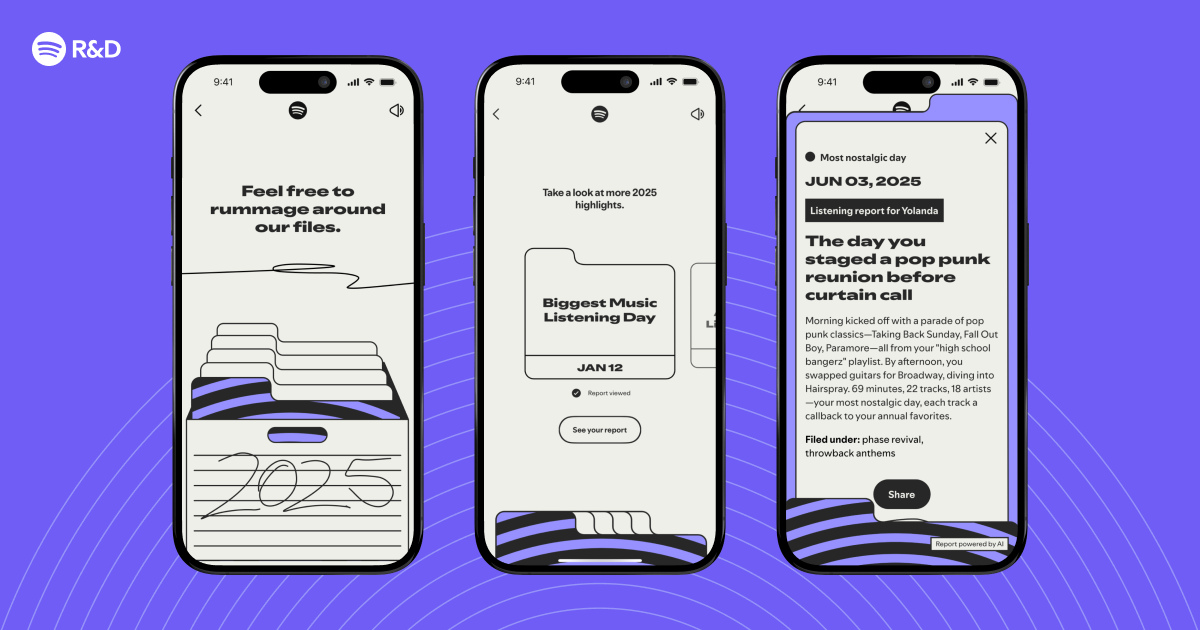
Instead of just counting top songs, the 2025 Wrapped uses temporal clustering to find sequences of tracks that form a coherent “moment.” For example, a last-minute study session before finals, a road trip playlist that repeated all summer, or a breakup playlist that emerged in October. These moments are identified using sequence models like LSTMs (Long Short-Term Memory networks) that learn to recognize emotional arcs and context shifts in your listening.
Personalizing the Storyline
Once moments are extracted, a narrative engine ranks them by a combination of recency, frequency, and uniqueness. A track you listened to 50 times but only in December might be considered a “discovery of the month,” while an artist you played every single week becomes your “top artist.” Special attention is given to anomalies—e.g., a sudden spike in a genre you normally avoid—as these often create the most engaging stories. The engine uses reinforcement learning to prioritize stories that users are most likely to share, based on previous years’ engagement data.
3. Balancing Personalization with Privacy
With great data comes great responsibility. Spotify’s engineering team has implemented several privacy-preserving techniques to ensure Wrapped remains fun, not intrusive. All personalized computations are performed on anonymized, aggregated data with differential privacy guarantees. This means that individual listening events cannot be traced back to a specific user in any query result.
Data Minimization and User Control
For Wrapped 2025, only data from users who have opted in to personalized features is used. Additionally, the system discards any raw logs after processing, keeping only the derived highlights. Users can also preview and edit their Wrapped before sharing, giving them control over what story is told.

4. Scaling to Millions: Infrastructure and Reliability
Generating Wrapped for over 500 million active users is a massive computational task. Spotify’s engineering team orchestrates a multi-stage batch processing pipeline that runs over several days in December.
Parallel Processing and Caching
Work is distributed across thousands of nodes using Apache Spark, with each user’s profile processed independently. Results are cached in a high-availability key-value store (e.g., Redis) to serve the surge of requests when Wrapped goes live. Load balancing and auto-scaling ensure that the frontend remains responsive even when millions of users view their Wrapped simultaneously.
Fault Tolerance and Fallbacks
If a particular user’s data processing fails (due to corrupt logs or timeouts), the system falls back to a simpler aggregation using precomputed stats (e.g., total minutes listened, top genres) to ensure everyone gets a Wrapped experience. Redundant storage across multiple geographic regions prevents data loss.
5. Making It Interactive: The Frontend Experience
The final step is presenting the story in an engaging, mobile-first format. Spotify’s frontend engineers use a combination of static site generation (for initial load) and dynamic client-side rendering (for interactive elements like quizzes and shareable cards).
Performance Optimization
Assets such as animated backgrounds and audio snippets are lazy-loaded and served from a CDN. The main narrative is delivered as a structured JSON payload, which the client interprets to render slides, transitions, and personal statistics. This separation allows the backend to be lightweight while the frontend provides a rich experience.
Internal anchor links throughout the experience allow users to jump back to key moments, such as their top artist or most surprising discovery, enhancing navigation within the story.
Conclusion: The Future of Personalized Listening Stories
Spotify Wrapped 2025 is a testament to the power of combining robust data engineering, advanced machine learning, and thoughtful privacy design. By identifying the interesting listening moments that define your year, Spotify doesn’t just report your stats—it tells your story. As technology evolves, we can expect even deeper personalization, perhaps incorporating mood detection or collaborative stories with friends. For now, enjoy your Wrapped, knowing that behind every slide is a world of engineering innovation.