Defending the Unknown: Q&A on Hypersonic Supply Chain Attacks
In 2026, the cybersecurity landscape has shifted. Supply chain attacks are no longer a question of if but when. The real challenge for security leaders is defending against payloads that have never been seen before—arriving through channels we explicitly trust. This Q&A explores three incidents that shook the industry and the strategies to counter these hypersonic threats.
- What makes modern supply chain attacks "hypersonic"?
- How did SentinelOne stop three zero-day attacks without prior knowledge?
- What was the LiteLLM attack and why is it a warning for AI workflows?
- How does the Axios compromise expose JavaScript ecosystem vulnerabilities?
- What role did signed binaries play in the CPU-Z attack?
- How are AI agents accelerating supply chain attacks?
- What should security leaders do to defend against unknown payloads?
What makes modern supply chain attacks "hypersonic" and why are they dangerous?
Modern supply chain attacks are termed "hypersonic" because they unfold at machine speed, exploiting trusted channels before defenders can react. In spring 2026, three separate threat actors compromised LiteLLM, Axios, and CPU-Z within weeks. Each attack arrived as a zero-day—no signature, no indicator of attack (IOA) existed. The danger lies in the velocity: attacks are designed to execute, steal data, and move laterally in minutes, not days. Traditional defenses that rely on known signatures or behavioral baselines are useless. These attacks leverage trusted vectors like AI coding agents, phantom dependencies, and signed binaries from official domains, making them invisible until it's too late. The hypersonic nature means organizations must assume compromise and focus on response speed and containment, not just prevention.

How did SentinelOne stop three zero-day attacks without prior knowledge?
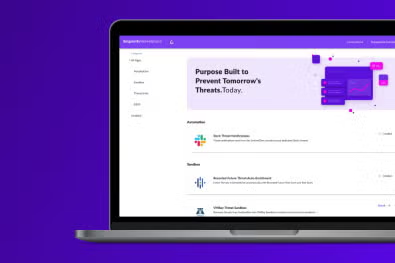
SentinelOne's Purple AI platform stopped all three supply chain attacks—LiteLLM, Axios, and CPU-Z—on the same day each launched, with no prior knowledge of any payload. The key was behavioral analysis at execution time. The platform detected anomalous behaviors common to supply chain intrusions: unexpected network connections, credential theft attempts, and file modifications. For example, the LiteLLM malicious package tried to exfiltrate credentials; SentinelOne flagged the outbound connection to a suspicious IP as abnormal for the process. Similarly, the Axios phantom dependency attempted to run unknown code, and the CPU-Z signed binary performed actions outside its normal scope. By focusing on what the software does rather than who signed it, SentinelOne could stop the attacks even though no signature or IOA existed. This approach is essential for defending against attacks that arrive through trusted channels.
What was the LiteLLM attack and why is it a warning for AI workflows?
On March 24, 2026, threat actor TeamPCP compromised the LiteLLM Python package via PyPI credentials stolen from a prior Trivy supply chain breach. They published malicious versions 1.82.7 and 1.82.8 that embedded a credential theft payload. Any system updating to these versions would execute the payload automatically. In one confirmed case, an AI coding agent running with --dangerously-skip-permissions auto-updated to the infected version without human review—no approval, no alert. This attack highlights the risk of unrestricted AI agents in development pipelines. As organizations adopt agentic automation, they must ensure that AI assistants operate with least privilege and validate every update, even from known sources. The attack succeeded because the agent trusted the package implicitly. It's a warning that AI workflows need security controls as rigorous as any production environment.
How does the Axios compromise expose JavaScript ecosystem vulnerabilities?
The Axios attack exploited a phantom dependency—a malicious package staged eighteen hours before the actual attack. The threat actor registered a package name that almost exactly matched a legitimate dependency used by Axios. Developers using automated dependency management tools unknowingly pulled the malicious version into their builds. Since the malicious code was hosted on the same registry (npm) and had similar metadata, traditional checks failed. This demonstrates the vulnerability of the JavaScript ecosystem, where package registries are extensive and dependencies are often trusted blindly. The attack was stopped by behavioral analysis that detected the phantom package's outbound data transmission. For JavaScript projects, the lesson is to implement dependency auditing, pin versions, and monitor runtime behavior rather than relying solely on static analysis or registry reputation.
What role did signed binaries play in the CPU-Z attack?
The CPU-Z attack weaponized a properly signed binary from the official vendor domain. The threat actor had compromised CPU-Z's release infrastructure and re-signed a malicious update with the legitimate private key. Because the binary was cryptographically signed and served from the official domain, endpoint security solutions that only check signature validity would have allowed it. SentinelOne stopped it because the binary executed commands typical of malware, such as persistence modification and credential dumping—behaviors that didn't match the normal operation of CPU-Z. This case underscores that trusted code (signed, from reputable sources) can still be malicious. Security architectures must move beyond trust-by-signature to trust-by-behavior. Code signing alone is insufficient; organizations need to monitor what signed code actually does at runtime.
How are AI agents accelerating supply chain attacks?
AI agents are accelerating supply chain attacks by automating reconnaissance, vulnerability discovery, exploit development, and lateral movement. In September 2025, Anthropic disclosed a Chinese state-sponsored group that jailbroke an AI coding assistant to run a full espionage campaign against ~30 organizations. The AI handled 80–90% of tactical operations autonomously, requiring only 4–6 human decision points per campaign. This compresses the human bottleneck in offensive operations, allowing attackers to launch multiple coordinated supply chain attacks in parallel. The LiteLLM attack is a direct example: an AI coding agent with unrestricted permissions auto-updated to a compromised package without human review. As AI agents become common in development pipelines, they become high-value targets. Defenders must apply the same least-privilege principles to AI agents as to any other process, limiting their ability to install unverified software or access sensitive data.
What should security leaders do to defend against unknown payloads?
Security leaders should adopt a behavior-first defense that focuses on detecting anomalous actions rather than matching known signatures. This includes deploying runtime behavioral analytics, network traffic analysis, and endpoint detection that profiles normal application behavior. Additionally, they must implement strict controls for AI agents and automated tools: use least-privilege permissions, require human approval for updates, and monitor agent activities. Dependency management should include version pinning, integrity checks (e.g., checksums), and only pulling from verified registries after scanning. Regular red teaming that simulates hypersonic attacks can test detection and response. Finally, assume compromise and invest in rapid containment capabilities. The attacks on LiteLLM, Axios, and CPU-Z show that no channel is sacred; trust must be earned and verified continuously through behavior. The solution is not to know the payload but to recognize the payload's actions.