Meta Launches Adaptive Ranking Model to Bring LLM-Scale Intelligence to Ads, Driving 3% Conversion Lift
The Breakthrough
Meta has deployed a new AI recommendation system, the Meta Adaptive Ranking Model, that enables the company to serve large language model (LLM)-scale ad ranking models in real time. The system is already live on Instagram since Q4 2025, delivering a +3% increase in ad conversions and a +5% increase in click-through rate for targeted users, Meta confirmed today.
“This is the first time we’ve been able to apply LLM-level complexity to ad ranking while maintaining the sub-second latency that billions of users expect,” said a Meta spokesperson in an exclusive statement. “The model dynamically adjusts its complexity based on each person’s context and intent, solving the fundamental tension between accuracy and speed.”
Background: The Inference Trilemma
Scaling ad recommendation to LLM-size has long been hindered by what Meta calls the “inference trilemma” — the challenge of balancing model complexity, compute cost, and low latency. Traditional one-size-fits-all inference could not deliver LLM-scale models within the strict response time requirements of a global advertising platform.
To break through this barrier, Meta’s team redesigned the entire inference stack around three key innovations: inference-efficient model scaling, model/system co-design, and reimagined serving infrastructure. These changes enable the system to serve models with up to one trillion parameters — O(1T) parameter scaling — while keeping response times under a second.
What This Means for Advertisers
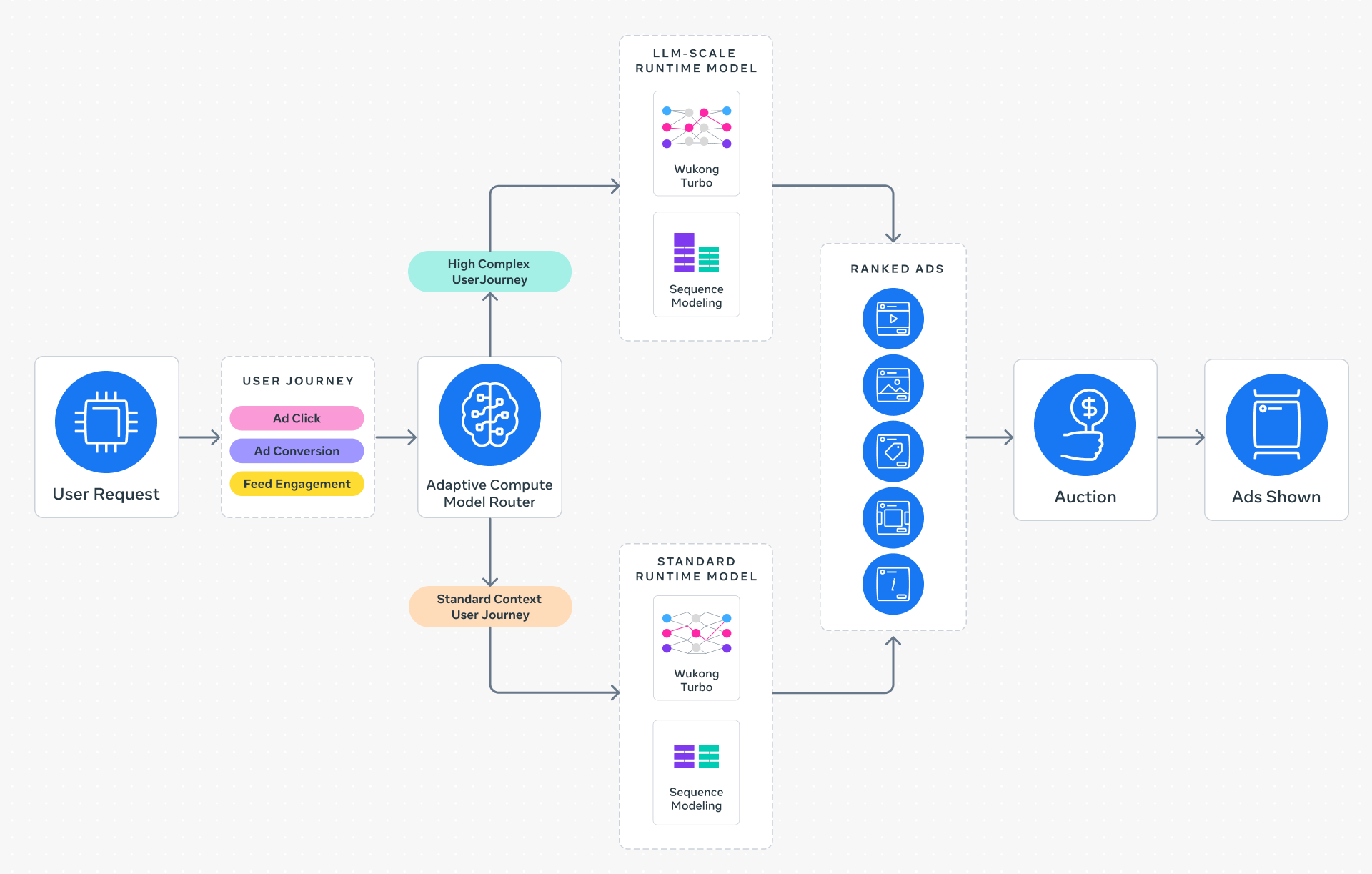
Advertisers using Meta’s platform will benefit from deeper understanding of user intent without sacrificing performance. The Adaptive Ranking Model replaces a rigid, uniform inference approach with a request-centric routing system that selects the optimal model for each user, context, and device.
Industry analyst Dr. Lena Park of AI Market Research commented: “Meta has effectively bent the inference scaling curve. This isn’t just incremental — it’s a structural shift that could redefine how real-time AI systems are built at scale. Smaller businesses especially will see higher ROI because the system matches ad delivery to user interest with unprecedented precision.”
- Inference-Efficient Model Scaling: Shifts to a request-centric architecture, serving LLM-scale models at sub-second latency.
- Model/System Co-Design: Hardware-aware architectures that align with silicon capabilities to maximize utilization.
- Reimagined Serving Infrastructure: Multi-card hardware and specific optimizations enable trillion-parameter model serving.
Industry Reaction and Next Steps
The system has already processed billions of requests on Instagram, with Meta indicating plans to expand to Facebook and other surfaces in 2026. The company emphasized that the technology was built with cost efficiency in mind, meaning the conversion gains come without a proportional increase in compute spend.
“We’ve proven that LLM-scale intelligence and real-time ad serving are not mutually exclusive,” the Meta spokesperson added. “This is the new baseline for recommendation systems.”