Unveiling the Secrets of Dolphin Speed: How Vortex Rings Propel These Marine Athletes
Introduction: The Enduring Mystery of Dolphin Locomotion
Dolphins are celebrated for their effortless speed and agility in water, often leaving observers and scientists alike in awe. For decades, the precise mechanisms behind their remarkable swimming abilities have remained elusive. While it has long been known that dolphins use their powerful tails—flukes—to generate forward motion, the detailed fluid dynamics at play were poorly understood. Recent advances in computational modeling have finally begun to lift the veil on this aquatic enigma. Japanese researchers from the University of Osaka employed state-of-the-art supercomputer simulations to dissect the complex flow patterns created by dolphin kicks, revealing that the secret lies in the formation of vortex rings and their cascading behavior. This article explores their groundbreaking findings, published in the journal Physical Review Fluids, and what they reveal about one of nature's most efficient swimmers.
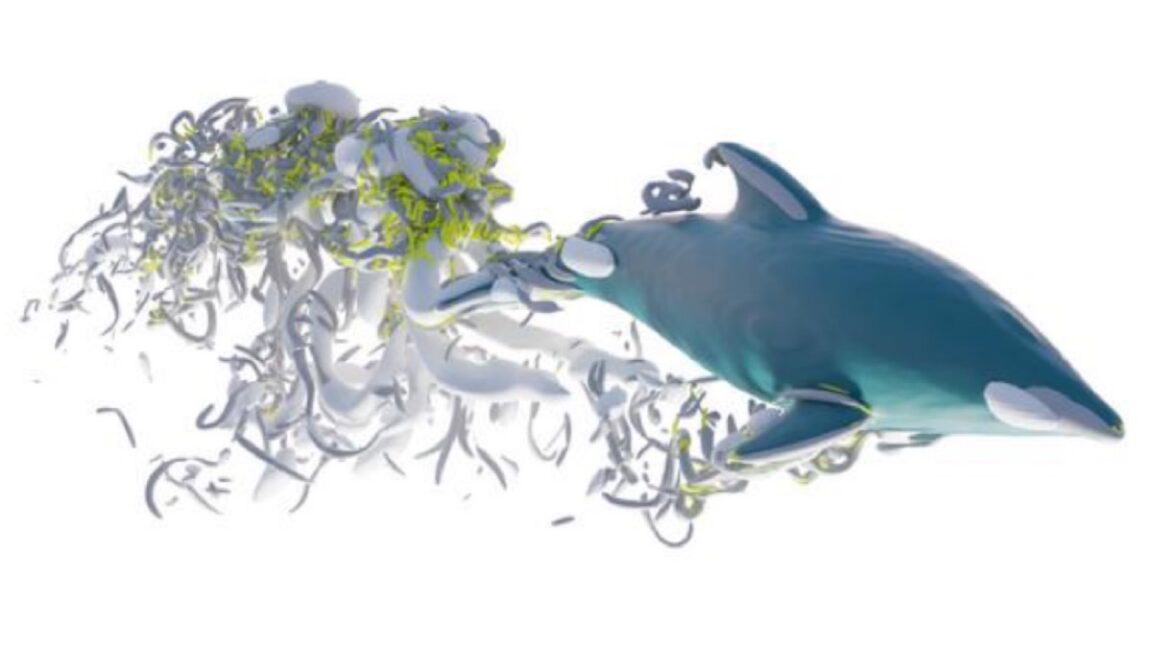
The Role of Vortex Rings in Dolphin Propulsion
When a dolphin flaps its tail up and down, the motion pushes water backward, generating a series of swirling currents known as vortices. These vortices vary in size and intensity, and their interplay is critical for efficient propulsion. The Osaka team's simulations allowed them to break down these complex flow structures with unprecedented resolution. They discovered that the initial tail oscillations produce large, coherent vortex rings—essentially doughnut-shaped loops of rotating water—that generate substantial thrust. These large rings are the primary drivers of forward motion, acting like invisible propellers that pull the dolphin through the water.
Why Smaller Vortices Do Not Contribute to Thrust
An intriguing aspect of the findings is that the large vortex rings subsequently break down into many smaller vortices. However, unlike the larger rings, these smaller eddies do not contribute to forward propulsion. Instead, they represent a dissipation of energy—a natural consequence of the turbulent flow. Why does nature produce them if they are not beneficial? The researchers hypothesize that the smaller vortices may play a role in stabilizing the dolphin's body or in reducing drag in certain phases of the stroke, but their primary effect is simply to redistribute energy from the larger rings. This insight is crucial because it challenges previous assumptions that all vortices produced by a swimming dolphin are equally useful for generating speed.
How Supercomputer Simulations Cracked the Code
To achieve these insights, the University of Osaka team relied on high-performance computing, running simulations that modeled the fluid dynamics of a dolphin's tail stroke in exquisite detail. The simulations mimicked the complex geometry of a real dolphin fluke and the surrounding water, solving the Navier-Stokes equations that govern fluid motion. By adjusting parameters such as tail beat frequency and amplitude, the team could isolate the effects of each variable on vortex formation. The computational power allowed them to resolve both the large-scale flow structures and the tiny eddies that would be impossible to observe experimentally. This approach not only confirmed the importance of vortex rings but also provided a quantitative framework for understanding how dolphins optimize their swimming efficiency.
Broader Implications for Science and Technology
The findings from this study extend beyond pure biology. Understanding how dolphins achieve high-speed swimming with minimal energy expenditure has inspired engineers working on biomimetic designs for underwater vehicles, propellers, and even swimwear. The principle of generating thrust from large vortex rings, while allowing smaller, non-propulsive vortices to dissipate, could lead to more efficient propulsion systems for submarines or autonomous underwater drones. Moreover, the research underscores the value of high-fidelity simulations in unraveling natural phenomena that are difficult to observe directly. As computational power continues to grow, we can expect even more secrets of animal locomotion to be unlocked.
Conclusion: A Glimpse into Dolphin Dynamics
The work by the Japanese team represents a significant step forward in our understanding of dolphin hydrodynamics. By identifying the hierarchical vortex structure—where initial large rings provide thrust and subsequent smaller vortices do not—they have clarified a long-standing question in marine biology. While many mysteries remain, such as how dolphins coordinate their entire body during high-speed turns or how they minimize drag over their skin, this study provides a solid foundation for future research. It also reminds us that even the most familiar animals still hold surprises, and that cutting-edge technology can illuminate the hidden physics of the natural world.
For further reading on the original research, see the full article in Physical Review Fluids (link not provided).